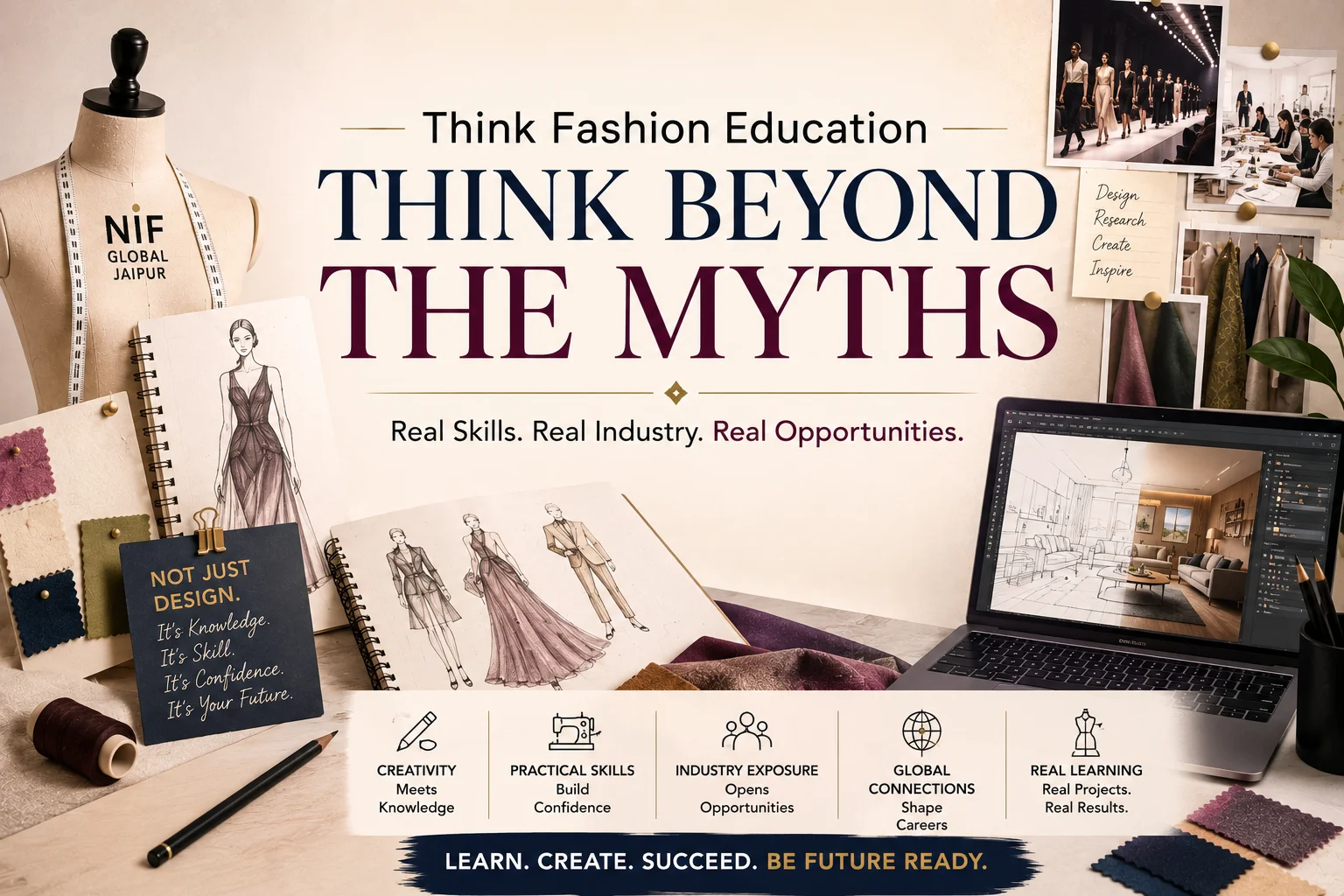
Fashion design courses are not only for students who can sketch perfectly or dream of becoming celebrity designers. NIF Global Jaipur helps students build practical skills in design, styling, textiles, garment construction, and industry practices, making fashion education suitable for students with different creative strengths.
Fashion is a creative industry, but a successful career in it requires much more than creativity. Many students and parents hesitate to choose fashion design because of common misconceptions about courses, careers, and the skills involved. Let’s separate these myths from reality.

Is fashion design only for students who are good at drawing?
Myth: You need exceptional drawing skills before joining a fashion design course.
Reality: Sketching is useful, but it is a skill that students can develop with practice. Fashion education also covers color, textiles, garment construction, styling, research, trend analysis, and design development.
A student may start with basic drawing skills and improve through regular assignments. What matters more is curiosity, observation, and the willingness to learn.
Do fashion design courses only prepare students to become fashion designers?
Myth: The only career after a fashion design course is becoming a fashion designer.
Reality: Fashion is a broad industry with many career paths. Students can explore roles in fashion styling, merchandising, textile design, costume design, fashion communication, visual merchandising, retail, fashion buying, and entrepreneurship.
The right course can help students understand these different areas before deciding where their interests fit best.
Is fashion design all about creativity and no technical skills?
Myth: Fashion students spend their time coming up with creative ideas and making attractive sketches.
Reality: Creativity is only one part of fashion education. Students also need to understand fabrics, measurements, construction techniques, garment development, and production processes.
A good fashion professional must turn an idea into something that can actually be made and worn. This is why practical learning is an important part of fashion education.
Are fashion design courses only useful for students from fashion backgrounds?
Myth: Students need prior experience in fashion or a family background in the industry.
Reality: Students can begin learning fashion without professional experience. A structured course introduces them to the fundamentals and gradually builds their skills.
Institutions with an established industry focus can also expose students to professional practices and changing trends. NIF Global Jaipur draws on a legacy of more than 30 years, with 35,000+ students and 1 lakh+ alumni across its wider network.
The learning environment also benefits from industry connections and celebrity mentors such as Manish Malhotra, Gauri Khan, and Twinkle Khanna.
Does a fashion design course guarantee a glamorous career?
Myth: Studying fashion automatically means attending fashion weeks, working with celebrities, or becoming famous.
Reality: Fashion can offer exciting opportunities, but the industry also demands discipline, technical knowledge, and persistence. Students need to develop portfolios, understand deadlines, work with teams, and respond to changing consumer preferences.
Industry exposure can help students understand these expectations. NIF Global’s collaborations and industry associations include Dubai Fashion Week, the London School of Trends, and Monacelli Italy. Its stated academic ecosystem also includes associations with De Montfort University, NSDC, Skill India, and Medhavi Skills University.
A fashion course should therefore be viewed as preparation for an industry, not simply a route to glamour.
Choosing a fashion design course becomes easier when students look beyond common myths and understand what the education and industry actually demand. Explore the fashion design courses at NIF Global Jaipur to understand the available learning pathways and take the next step towards a career in fashion.
FAQ’s
Q1. Is fashion design a good career option after Class 10 or 12?
NIF Global Jaipur offers fashion education pathways that can suit students starting after Class 10 as well as those pursuing further education after Class 12. Students can choose a program based on their academic stage, interests, and career goals.
Q2. Do I need to know fashion before joining a fashion design course?
NIF Global Jaipur introduces students to the fundamentals of fashion design, so prior professional experience is not essential. Students develop their creative and technical abilities through structured learning and practical work.
Q3. What skills do fashion design courses teach?
NIF Global Jaipur’s fashion-focused education can help students develop skills across design, styling, textiles, garment development, and industry practices. Students also need communication, research, presentation, and problem-solving skills to succeed in fashion careers.
Q4. What careers can I pursue after studying fashion design?
NIF Global Jaipur prepares students to explore different areas of the fashion industry rather than limiting them to one career path. Possible directions include fashion design, styling, merchandising, textile design, fashion communication, visual merchandising, retail, and entrepreneurship.
Q5. Is fashion design only about creativity?
NIF Global Jaipur recognizes that fashion requires both creative and technical skills. Students need to understand how ideas develop into practical garments and products, which makes technical knowledge as important as creative thinking.

Leave a Reply