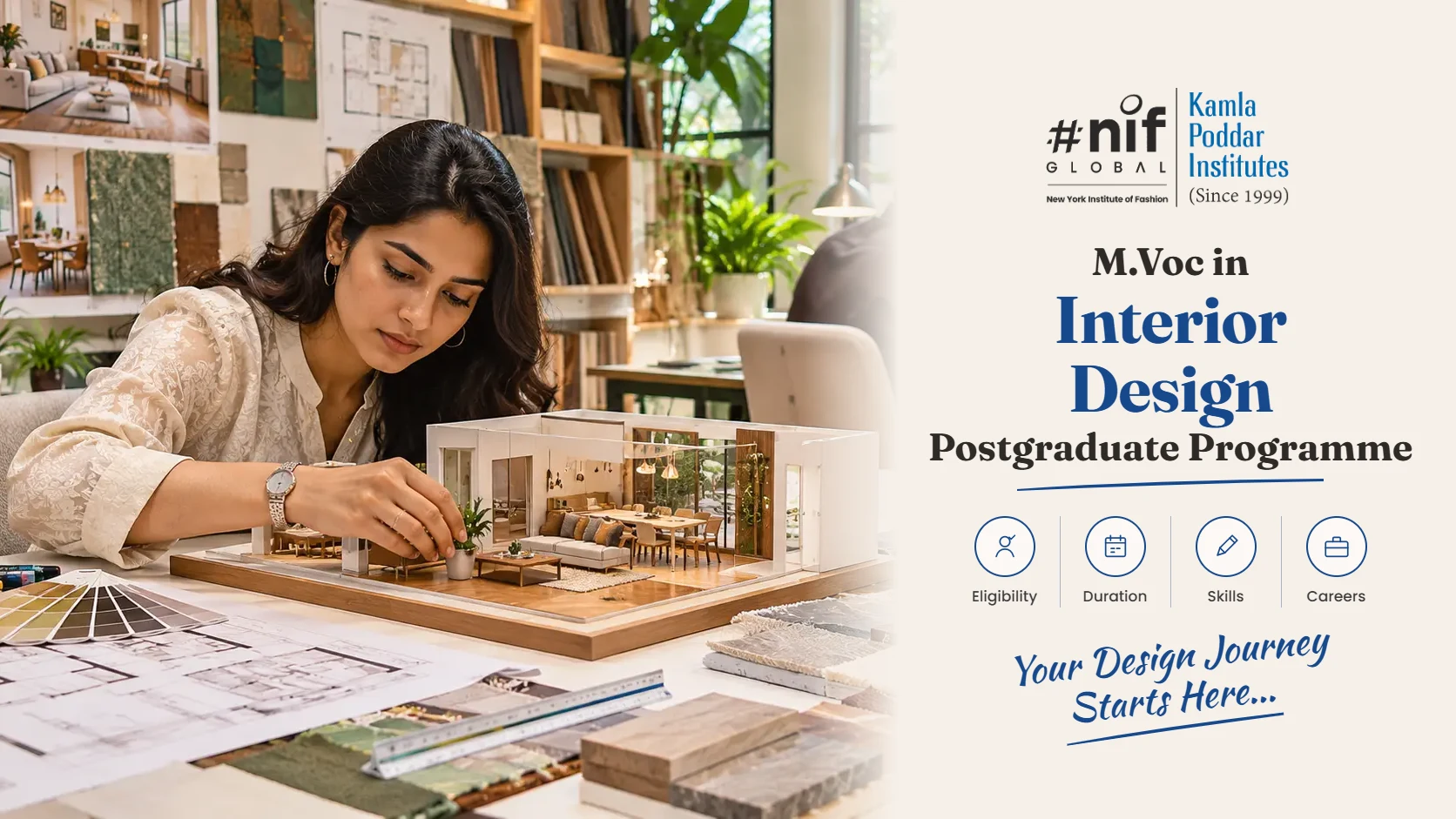
For graduates interested in developing their knowledge of interior spaces, materials and professional design practices, an M.Voc in Interior Design offers a postgraduate pathway focused on vocational education and applied learning.
Interior Design involves more than selecting furniture, colours or decorative elements. Professionals must consider how people use spaces, how different materials perform, how lighting affects an environment and how design decisions respond to functional, aesthetic and practical requirements.
As projects become more complex, designers may also need stronger skills in research, client communication, project coordination and sustainable design thinking.
An M.Voc programme, referred to here as Master in Vocation Studies in Interior Design, provides an opportunity to explore these professional demands through postgraduate study. However, eligibility, practical training and the subjects covered can differ between institutions.
This guide explains the M.Voc Interior Design course, eligibility requirements, duration, important professional skills and possible career opportunities. It also outlines the two-year postgraduate programme offered at NIF Global Jaipur.
What Is M.Voc in Interior Design?
M.Voc in Interior Design is a postgraduate qualification that combines advanced subject knowledge with a vocational or professionally oriented approach to learning.
The programme is intended for graduates who want to continue their education and develop competencies relevant to interior design practice.
Depending on the university, postgraduate interior design education may involve spatial planning, materials, furniture, lighting, sustainability, technical communication, design research and project development.
Vocational programmes generally place particular importance on applying knowledge to realistic tasks and professional situations. However, the balance between academic study, practical assignments and industry exposure depends on the actual course structure.
Students should therefore review a programme’s official curriculum and learning outcomes rather than assuming that every M.Voc Interior Design course offers identical training.
M.Voc in Interior Design: Course Overview
NIF Global Jaipur lists a two-year M.Voc in Interior Design in association with Medhavi Skills University.
The institute describes the programme as developing the knowledge, competencies and skills required to respond to a changing professional environment. Its published description highlights a strategic approach to practical issues and contemporary interior design concepts.
| Course Detail | Information |
| Programme | M.Voc in Interior Design |
| Qualification level | Postgraduate |
| Duration at NIF Global Jaipur | 2 years |
| Published eligibility | Graduate or equivalent |
| Academic association | Medhavi Skills University |
| Programme emphasis | Strategic thinking, practical design challenges and professional competencies |
Medhavi Skills University’s official M.Voc Interior Design page also confirms a two-year duration and lists graduation in any stream as the academic eligibility requirement.
Applicants should confirm the current admission process, course fees, assessment requirements and detailed syllabus before enrolling.
Eligibility for M.Voc in Interior Design
Eligibility is one of the first factors graduates should check when considering postgraduate interior design education.
NIF Global Jaipur states that applicants for its M.Voc in Interior Design must be graduates or hold an equivalent qualification.
Medhavi Skills University’s published programme information specifies graduation in any stream.
Can Graduates From Other Academic Streams Apply?
Yes, according to Medhavi Skills University’s published graduation-in-any-stream eligibility requirement.
However, students entering from non-design backgrounds should understand that interior design involves specialist visual, technical and spatial skills.
Before applying, they should ask whether the programme provides appropriate introductory support, whether previous design knowledge is expected and how practical competencies are assessed.
Can B.Des and B.Voc Graduates Apply?
Graduates holding recognised undergraduate qualifications such as B.Des or B.Voc may be eligible, subject to verification of their degree and the current admission requirements.
Those with previous education in Interior Design may already be familiar with design fundamentals, drawings, materials and spatial planning. Postgraduate study can offer an opportunity to build upon that foundation.
Can BA, B.Com or B.Sc Graduates Apply?
Medhavi Skills University lists graduation in any stream, which may include eligible BA, B.Com and B.Sc graduates.
Applicants should nevertheless confirm the recognition of their qualification, any additional selection conditions and whether preparatory design skills are recommended.
Is an Entrance Examination Required?
Admission procedures vary between institutions. Some postgraduate design programmes require portfolios, interviews or entrance assessments.
The publicly available NIF Global Jaipur M.Voc Interior Design description does not specify a compulsory entrance examination.
This should not be interpreted as confirmation that no assessment is required. Applicants should request the latest admission procedure directly from the institute.
What Is the Duration of M.Voc in Interior Design?
At NIF Global Jaipur, the M.Voc in Interior Design is a two-year postgraduate programme.
The programme is intended for eligible graduates interested in developing advanced professional competencies.
The precise academic calendar, semester structure, practical training schedule and assessment pattern should be confirmed through the university’s current course documentation.
Students should also distinguish the two-year M.Voc degree from separate postgraduate certificate programmes. These are different qualifications with their own duration, requirements and learning outcomes.
Important Skills in Postgraduate Interior Design Education
Interior Design requires creative thinking supported by technical knowledge and an understanding of how spaces function.
At a postgraduate level, students should evaluate whether a course helps them strengthen skills relevant to more complex design decisions and professional responsibilities.
The following areas are important within contemporary interior design practice. They provide a useful framework for evaluating M.Voc programmes, although they are not presented as a confirmed list of subjects taught at NIF Global Jaipur.
1. Advanced Space Planning
Space planning involves understanding how people move through and use an interior environment.
Designers must consider circulation, furniture placement, accessibility, room functions and the relationships between different areas.
For example, designing an office may require balancing individual workstations, collaborative spaces, privacy and movement between departments.
Advanced spatial thinking helps designers develop layouts that respond to specific users and operational needs.
2. Materials and Finishes
Material selection influences an interior’s appearance, performance, maintenance and cost.
Interior designers may need to evaluate flooring, wall finishes, furniture materials and surface treatments according to durability, safety, usability and aesthetic goals.
Understanding material properties helps professionals make informed choices instead of selecting products solely for their visual appeal.
3. Lighting and Environmental Design
Lighting affects how an interior looks, functions and feels.
Relevant professional knowledge includes daylight, artificial lighting, task requirements and the relationship between lighting and interior materials.
Different spaces demand different lighting approaches. A retail store, classroom, restaurant and residential bedroom cannot all be planned in the same way.
4. Sustainable Interior Design
Sustainability has become an important consideration in the built environment.
Interior designers may evaluate resource efficiency, material longevity, waste reduction, indoor environmental quality and the possibilities of reusing existing spaces or materials.
For example, a renovation project may involve determining which existing fixtures can be retained rather than replacing every element.
Students interested in sustainable design should look for courses that provide substantive teaching on responsible material selection and environmental decision-making.
5. Technical Drawing and Digital Communication
Interior design ideas must be communicated clearly before they can be developed into practical projects.
Designers may use plans, elevations, technical details, three-dimensional models and digital presentations to communicate concepts and requirements.
Common industry tools include CAD and three-dimensional modelling software. However, students should confirm which specific applications, if any, are included in the official curriculum.
6. Furniture and Interior Product Understanding
Furniture affects how people interact with spaces and can influence comfort, movement and visual balance.
Design professionals may need to understand dimensions, materials, usability, furniture placement and relationships between individual elements.
Knowledge of furniture design and selection can be especially relevant to residential, hospitality and commercial projects.
7. Design Research and Problem-Solving
Research helps designers understand client expectations, user needs and the conditions affecting a project.
Depending on the assignment, this may involve site analysis, precedent studies, observations, interviews and comparisons of alternative design solutions.
Research-led thinking encourages students to explain why a proposed solution is appropriate rather than relying entirely on personal preferences.
8. Project Coordination and Professional Communication
Interior design projects often involve multiple participants, including clients, consultants, contractors, vendors and other design professionals.
Project coordination requires an understanding of responsibilities, timelines, communication and the relationship between design decisions and implementation.
Professionals must also be able to present ideas, receive feedback and document changes clearly.
M.Voc Interior Design Curriculum: What Should Students Verify?
The exact M.Voc Interior Design syllabus depends on the institution and academic regulations.
Published postgraduate vocational curricula from other universities include subjects or learning areas relating to space planning, digital design, materials, furniture, sustainability, entrepreneurship and research.
However, these examples cannot be treated as the official NIF Global Jaipur syllabus.
When requesting the detailed curriculum, students should examine:
- The semester-wise subject list
- Practical assignments and studio requirements
- Technical drawing and software training
- Project and portfolio assessment methods
- Research or dissertation requirements, if applicable
- Any confirmed industry training arrangements
- Examination, attendance and academic progression requirements
NIF Global Jaipur’s published M.Voc description confirms a focus on practical issues, strategic concepts and professional competencies. The current public page does not provide a complete semester-wise syllabus.
Students should obtain the latest official course documentation before making an admission decision.
How Is M.Voc Interior Design Different From B.Voc and B.Des?
Students researching postgraduate courses may also encounter undergraduate qualifications such as B.Voc and B.Des in Interior Design.
These programmes differ in qualification level, duration and entry requirements.
| Factor | B.Voc Interior Design | B.Des Interior Design | M.Voc Interior Design |
| Qualification level | Undergraduate | Undergraduate | Postgraduate |
| Duration at NIF Global Jaipur | 3 years | 4 years | 2 years |
| Published eligibility | Class 12 or equivalent | Class 12 or equivalent | Graduate or equivalent |
| Published focus | Project-led vocational learning | Experiential and luxury interior design | Strategic concepts and advanced professional competencies |
| Intended academic stage | Initial undergraduate education | Initial undergraduate education | Education after graduation |
The M.Voc is not a replacement for the undergraduate entry requirement. Students generally need an eligible bachelor’s qualification before pursuing the programme.
Similarly, a four-year B.Des and a two-year M.Voc should not be compared only by duration because they represent different academic levels.
M.Voc in Interior Design vs M.Des: What Is the Difference?
M.Voc and M.Des are both postgraduate design-related qualifications, but their academic orientation can differ.
An M.Voc typically emphasises vocational competencies, practical learning and professional application.
An M.Des, or Master of Design, may emphasise advanced design inquiry, specialisation, research and studio practice, depending on the programme.
Both can involve substantial practical work and research. Neither qualification is automatically superior for every career.
Students should evaluate the specific curriculum, awarding university, practical facilities and intended professional outcomes before choosing between them.
Career Opportunities After M.Voc in Interior Design
Interior Design offers career pathways across residential, commercial, retail, hospitality and other built environments.
NIF Global Jaipur lists several possible Interior Design career directions on its official website, including residential, commercial, hospitality, healthcare and sustainable interior design.
Additional listed directions include furniture design, retail interiors, set design, exhibition design and freelance practice.
These are broader industry opportunities rather than guaranteed M.Voc-specific jobs or placements.
1. Residential Interior Designer
Residential interior designers work on living environments such as apartments, houses and other homes.
Projects can involve space planning, furniture selection, materials, lighting and understanding the lifestyle requirements of residents.
2. Commercial Interior Designer
Commercial interior design involves spaces such as offices, business premises and professional environments.
Designers must consider functional requirements, the activities carried out in the space and coordination with other project stakeholders.
3. Hospitality Interior Designer
Hospitality projects may include hotels, restaurants, cafés and related spaces.
Design decisions often need to balance customer experience, operations, materials, comfort and the identity of the business.
4. Retail Interior Designer
Retail interior design focuses on how products and customers interact within a commercial environment.
Relevant work may involve store layouts, product display areas, circulation, lighting and coordination with visual merchandising teams.
5. Furniture Designer
Furniture design involves developing products that respond to functional, ergonomic, material and visual considerations.
Professionals may collaborate with interior designers, manufacturers, product developers and specialised furniture businesses.
6. Sustainable Interior Design
Designers interested in sustainability may explore projects involving responsible materials, resource efficiency, reuse and environmental performance.
Specialist roles can require additional technical knowledge, experience or relevant professional training.
7. Exhibition and Set Design
Exhibition and set design can involve creating temporary or specialised spatial environments for events, displays and productions.
Such work may demand skills in conceptual development, technical communication and collaboration with production teams.
8. Freelance Interior Design
Some professionals choose to work independently with clients on interior design assignments.
Freelance practice requires more than design knowledge. Professionals must manage client communication, quotations, scheduling, coordination and business responsibilities.
Graduates should build appropriate experience and understand the professional requirements of the services they intend to offer.
Is M.Voc in Interior Design a Good Choice After Graduation?
An M.Voc in Interior Design may be suitable for graduates interested in continuing their education through a professionally oriented postgraduate programme.
It may appeal to students who:
- Want to develop their understanding of advanced interior design challenges
- Are interested in vocational learning and professional application
- Want to strengthen spatial, creative and technical competencies
- Wish to explore design research, project thinking and practical problem-solving
- Are considering further education before pursuing a particular Interior Design career
However, students from different academic backgrounds may have different preparation needs.
A graduate who has already studied Interior Design may want to develop specialised knowledge, while a graduate from another discipline may first need to strengthen foundational drawing, spatial and material understanding.
The suitability of a specific course should therefore be assessed against the student’s previous education and the actual programme syllabus.
What Should You Check Before Applying for M.Voc Interior Design?
Before selecting a postgraduate Interior Design course, applicants should request verified information about the qualification and learning experience.
- Eligibility: Confirm accepted bachelor’s qualifications and any additional admission conditions.
- University association: Verify the degree-awarding institution and current academic regulations.
- Detailed curriculum: Review subject lists, practical modules and assessment requirements.
- Digital skills: Ask which drafting, modelling or presentation tools are included.
- Practical exposure: Confirm the structure of studio work, projects and any industry training.
- Portfolio expectations: Check admission portfolio requirements and student-project assessments.
- Course fees: Request written tuition details and information about additional expenses.
- Academic schedule: Confirm commencement dates, attendance requirements and examinations.
- Career support: Understand the mentoring and professional development opportunities actually available.
These checks can help applicants make an informed decision based on the course itself rather than general claims about the Interior Design industry.
Study M.Voc in Interior Design at NIF Global Jaipur
NIF Global Jaipur offers a two-year M.Voc in Interior Design for eligible graduates, in association with Medhavi Skills University.
The programme is described as developing the knowledge, competencies and strategic thinking necessary to address practical challenges in modern interior design.
For graduates interested in postgraduate Interior Design education, the course provides an option to explore advanced vocational learning and professional development.
Visit the Interior Design Courses at NIF Global Jaipur page to review the official programme information.
Considering M.Voc in Interior Design after graduation? Contact the NIF Global Jaipur admissions team to confirm your eligibility, request the current syllabus and understand the programme’s fees, admission process and academic schedule.
Frequently Asked Questions
Q1. What is M.Voc in Interior Design?
M.Voc in Interior Design is a postgraduate programme focused on professional competencies and applied learning related to interior design. It is referred to as Master in Vocation Studies in Interior Design in this guide. The exact syllabus depends on the university.
Q2. What is the duration of M.Voc in Interior Design?
NIF Global Jaipur offers a two-year M.Voc in Interior Design programme.
Q3. What is the eligibility for M.Voc in Interior Design?
NIF Global Jaipur lists graduate or equivalent as the eligibility requirement. Medhavi Skills University’s published programme information specifies graduation in any stream.
Q4. Can I pursue M.Voc Interior Design after BA, B.Com or B.Sc?
Graduates from these streams may be eligible under Medhavi Skills University’s graduation-in-any-stream criterion. Applicants should confirm qualification recognition and any additional admission requirements.
Q5. Can B.Voc Interior Design graduates apply for M.Voc?
Graduates holding an eligible recognised B.Voc qualification may apply, subject to the institution’s current admission rules.
Q6. What skills are important for M.Voc Interior Design students?
Relevant professional skills include space planning, material understanding, lighting, technical communication, research, sustainability and project coordination. Students should verify which skills are taught in their chosen programme.
Q7. Does M.Voc Interior Design include AutoCAD or 3D software?
Digital drafting and modelling tools are used across the Interior Design profession. However, NIF Global Jaipur’s publicly available M.Voc description does not identify specific software modules. Applicants should request the current syllabus.
Q8. Is M.Voc in Interior Design different from B.Des?
Yes. M.Voc is a postgraduate qualification for eligible graduates, while B.Des is an undergraduate design qualification. Their admission requirements, academic levels and course objectives differ.
Q9. What are the career opportunities after M.Voc Interior Design?
Possible directions include residential, commercial, hospitality and retail interior design, as well as furniture design, exhibition design and freelance practice. Opportunities depend on skills, experience and employer requirements.
Q10. Does NIF Global Jaipur offer M.Voc in Interior Design?
Yes. NIF Global Jaipur lists a two-year M.Voc in Interior Design with graduate-level eligibility and an emphasis on practical and strategic professional competencies.
Conclusion
An M.Voc in Interior Design offers eligible graduates a postgraduate pathway for exploring advanced knowledge, vocational competencies and the practical challenges of interior design work.
The important factors to consider include academic eligibility, programme duration, curriculum, professional skill development and future career interests.
At NIF Global Jaipur, the two-year M.Voc in Interior Design is positioned around strategic concepts and practical issues relevant to the changing design profession.
Before enrolling, students should confirm the latest course syllabus, admission requirements and learning opportunities to ensure that the programme aligns with their previous education and professional goals.
Explore the Interior Design courses at NIF Global Jaipur and contact the admissions team for further information about the M.Voc programme.
Leave a Reply