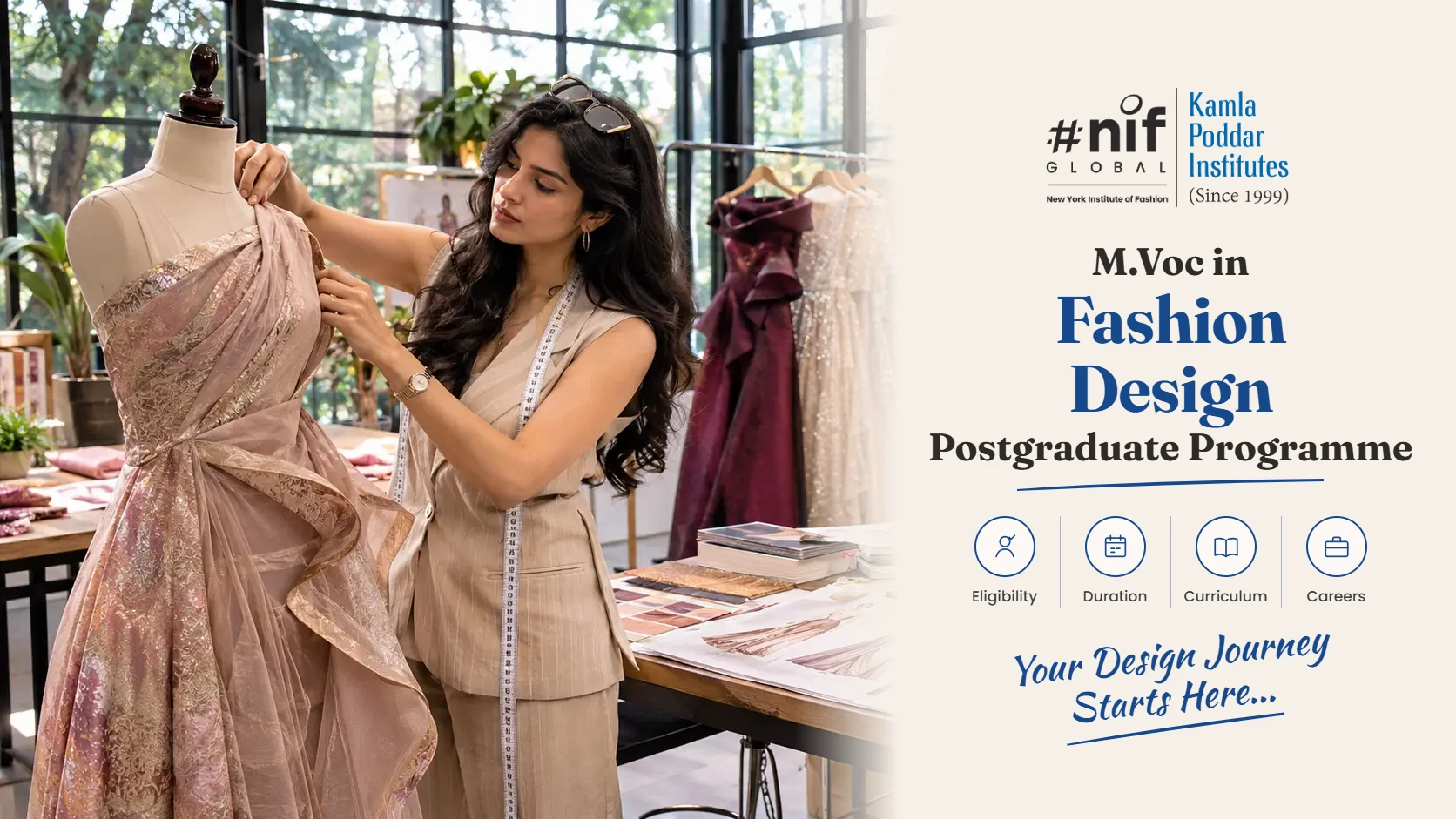
Completing an undergraduate degree does not have to mark the end of your fashion design education. For graduates interested in developing advanced creative and practical skills, an M.Voc in Fashion Design offers a postgraduate pathway focused on vocational learning and professional development.
The fashion industry involves much more than creating attractive garments. Designers and other professionals must understand materials, product development, consumer preferences, production processes and the practical requirements of turning creative ideas into finished products.
An M.Voc programme, referred to here as Master in Vocation Studies in Fashion Design, provides an opportunity to explore these connections through advanced learning and practical projects. However, the curriculum, admission requirements and industry exposure differ between institutions.
This guide explains the M.Voc Fashion Design course, its eligibility, duration, curriculum areas, practical learning methods and potential career opportunities. It also covers the two-year M.Voc programme offered at NIF Global Jaipur.
What Is M.Voc in Fashion Design?
M.Voc in Fashion Design is a postgraduate programme designed to develop advanced knowledge, vocational skills and professional competencies in the fashion industry.
Unlike an introductory design course, a postgraduate vocational programme is intended for students who have already completed a qualifying undergraduate education and want to pursue further learning.
Depending on the university, M.Voc Fashion Design programmes may address advanced design development, textiles, garment construction, fashion technology, research, production and related professional practices.
The defining characteristic is an emphasis on connecting academic learning with practical skills. However, students should assess the actual curriculum rather than assuming that every M.Voc programme teaches identical subjects.
M.Voc in Fashion Design: Course Overview
NIF Global Jaipur lists a two-year M.Voc in Fashion Design in association with Medhavi Skills University.
According to the institute’s published course description, the programme is designed to provide advanced knowledge and practical experience through project-led learning.
| Course Detail | Information |
| Programme | M.Voc in Fashion Design |
| Qualification level | Postgraduate |
| Duration at NIF Global Jaipur | 2 years |
| Published eligibility | Graduate or equivalent |
| Academic partner listed | Medhavi Skills University |
| Published learning approach | Project-led and practical-oriented |
| Listed learning activities | Lectures, workshops, industry visits and live presentations |
Medhavi Skills University’s M.Voc Fashion Design page also lists a two-year duration and graduation in any stream as the eligibility requirement.
Students should confirm the latest admission conditions, fee structure, academic calendar and programme documentation before applying.
Eligibility for M.Voc in Fashion Design
The first step in applying for an M.Voc Fashion Design course is understanding the academic qualifications accepted by the institution.
NIF Global Jaipur lists Graduate or equivalent as the eligibility requirement for its M.Voc in Fashion Design.
Medhavi Skills University’s programme page provides additional clarification by listing graduation in any stream.
Can Students From Other Academic Streams Apply?
Graduates from different academic backgrounds may be eligible, depending on the university’s admission rules.
For NIF Global Jaipur’s listed programme, Medhavi Skills University’s published eligibility states graduation in any stream. However, applicants without previous Fashion Design education should confirm whether preparatory knowledge, assessments or additional conditions apply to their chosen admission cycle.
Can B.Des and B.Voc Graduates Apply?
Graduates holding recognised bachelor’s qualifications, including relevant B.Des or B.Voc degrees, may be able to apply if they satisfy the programme’s current eligibility criteria.
A previous qualification in Fashion Design may provide useful preparation, but students should not assume that one undergraduate degree is compulsory unless specified in the official admission requirements.
Is an Entrance Examination Required?
Entrance examinations, interviews and portfolio requirements vary between universities.
NIF Global Jaipur’s publicly available M.Voc course description does not specify a compulsory entrance examination or portfolio test.
Applicants should contact the admissions team to confirm the current selection process rather than assuming that no assessment will be required.
What Is the Duration of M.Voc in Fashion Design?
At NIF Global Jaipur, the M.Voc in Fashion Design is a two-year postgraduate programme.
The course is described as combining advanced learning with practical activities intended to familiarise students with the design and garment industry.
Other universities may organise their M.Voc programmes into semesters or provide specific academic progression arrangements. Students should confirm the exact semester structure, assessment scheme and minimum attendance requirements of their selected programme.
The duration of the M.Voc degree should also not be confused with NIF Global Jaipur’s separate one-year postgraduate certificate programmes, which are listed as distinct qualifications.
M.Voc Fashion Design Curriculum: What Can Students Expect to Study?
The curriculum is one of the most important considerations when selecting a postgraduate Fashion Design programme.
Students should look for a balance between creative exploration, technical development, research and practical experience.
Across postgraduate vocational Fashion Design programmes, several established learning areas are relevant to advanced fashion education.
1. Advanced Fashion Design and Concept Development
Advanced design education involves examining how ideas are researched, developed and refined into a coherent fashion concept.
Students may explore design briefs, collection planning, visual research and the relationship between fashion products and their intended audiences.
The purpose is to move beyond isolated design ideas towards a more systematic approach to creative development.
2. Textiles and Material Exploration
Fabric and material knowledge is essential to developing practical fashion products.
Relevant postgraduate learning may explore textile characteristics, material selection, fabric behaviour, surface techniques and the relationship between materials and garment performance.
Material choices influence appearance, durability, comfort, production processes and cost.
3. Pattern Making and Garment Construction
Understanding garment development can help designers translate concepts into wearable products.
Depending on the curriculum, advanced fashion programmes may include pattern development, garment fitting, construction processes and technical problem-solving.
Students should check the level of technical training offered and whether the programme provides appropriate practical facilities.
4. Fashion Illustration and Digital Design
Visual communication enables designers to present ideas to collaborators, manufacturers and clients.
Relevant skills may include fashion illustration, technical drawings, digital presentations and the use of suitable design software.
The precise digital tools and software taught vary between institutions and should be verified through the official syllabus.
5. Fashion Research and Trend Analysis
Fashion research helps students understand changing consumer preferences, cultural influences, design developments and industry requirements.
Rather than simply following trends, advanced study may encourage students to examine why particular changes occur and how research can inform creative decisions.
6. Apparel Production and Industry Processes
The fashion industry relies on coordination between design, sampling, sourcing, manufacturing and product presentation.
Understanding these processes can help students recognise the practical requirements involved in bringing a fashion concept to market.
7. Fashion Business and Entrepreneurship
Fashion-related professional work can involve pricing, brand positioning, sourcing, customer research and business planning.
These areas are relevant to graduates interested in creative entrepreneurship or roles that connect design with commercial operations.
8. Research Projects and Portfolio Development
Advanced fashion education may involve substantial projects through which students demonstrate research, design thinking, technical decisions and presentation skills.
A well-documented portfolio can help communicate the student’s contribution, creative development and practical abilities.
Curriculum clarification: The topics above represent established learning areas in postgraduate Fashion Design education. They are not a confirmed semester-wise syllabus for NIF Global Jaipur. The institute’s official description specifically confirms project-led learning, lectures, workshops, industry visits and live presentations. Students should request the latest detailed syllabus for exact subjects.
Practical Learning in M.Voc Fashion Design at NIF Global Jaipur
NIF Global Jaipur describes its M.Voc programme as practical-oriented and project-led.
Its published programme information identifies four learning activities:
- Lectures: Supporting the academic and conceptual understanding relevant to advanced fashion education.
- Workshops: Providing opportunities for practical engagement and applied learning.
- Industry visits: Helping students become familiar with aspects of the design and garment industry.
- Live presentations: Creating opportunities to communicate ideas, explain project decisions and develop presentation skills.
These activities can be particularly relevant to vocational education because they connect learning with professional contexts.
However, the number of workshops, specific industry visits, internship arrangements and project requirements should be confirmed with the institute for the relevant academic session.
M.Voc vs B.Voc vs B.Des in Fashion Design
Students researching M.Voc Fashion Design may also encounter B.Voc and B.Des programmes. Understanding their qualification levels is essential.
| Factor | B.Voc Fashion Design | B.Des Fashion Design | M.Voc Fashion Design |
| Qualification level | Undergraduate | Undergraduate | Postgraduate |
| Duration at NIF Global Jaipur | 3 years | 4 years | 2 years |
| Published eligibility | Class 12 or equivalent | Class 12 or equivalent | Graduate or equivalent |
| Published programme emphasis | Project-led vocational design education | Luxury products, materials, development and business-related design | Advanced practical knowledge and project-led learning |
| Primary audience | Eligible students beginning undergraduate studies | Eligible students beginning undergraduate studies | Graduates seeking postgraduate education |
These qualifications are not interchangeable. B.Voc and B.Des are undergraduate degrees, while M.Voc is a postgraduate degree.
Students who have not yet completed a qualifying undergraduate programme should first explore appropriate bachelor’s-level options.
M.Voc in Fashion Design vs M.Des: What Is the Difference?
M.Voc and M.Des are both postgraduate qualifications, but their course structures and learning objectives may differ.
An M.Voc typically emphasises vocational competencies and applied professional learning. An M.Des, or Master of Design, may place greater emphasis on advanced design inquiry, specialised design practice, research and conceptual development, depending on the institution.
Both can include practical projects, research and industry engagement.
Students should compare the actual course curriculum, qualification requirements, portfolio expectations, awarding university and future study eligibility rather than assuming that one degree is universally superior.
Career Opportunities After M.Voc in Fashion Design
Fashion Design graduates can explore creative, technical and business-related career pathways. The opportunities available to an individual depend on their practical skills, portfolio, previous experience and employer requirements.
NIF Global Jaipur lists several fashion-related career directions on its official programme page, including Fashion Designer, Costume Designer, Fashion Stylist, Visual Merchandiser, Fashion Marketer or Buyer, Fashion House Coordinator, Fashion Illustrator, Pattern Maker and Fashion Forecaster.
These represent possibilities within the broader field of Fashion Design, not guaranteed job placements or M.Voc-specific employment outcomes.
1. Fashion Designer
Fashion designers develop clothing or accessories for particular customers, markets or creative briefs.
Their responsibilities may include research, sketching, material selection, design development and collaboration with sampling or production teams.
2. Apparel Product Development
Product development professionals help coordinate the process of transforming a design concept into a finished fashion product.
Relevant activities may include working with technical specifications, materials, samples, fitting requirements and production teams.
3. Costume Design
Costume designers develop or coordinate clothing for theatre, film, television and other productions.
Costume-related work requires research, visual interpretation, collaboration and an understanding of the needs of each production.
4. Fashion Styling
Fashion stylists select and coordinate clothing and accessories for personal clients, photography, advertising, fashion shows or media productions.
Graduates interested in styling should build relevant portfolios and practical experience alongside their design education.
5. Fashion Merchandising and Buying
Merchandising and buying functions involve understanding product ranges, consumer demand, seasonal planning and commercial considerations.
Such roles may require additional retail, financial or analytical skills beyond design knowledge.
6. Fashion Illustration and Creative Communication
Graduates with strong drawing and visual communication skills may explore illustration or related creative work for brands, publications and design teams.
7. Fashion Research and Trend Analysis
Research-oriented work involves examining fashion developments, materials, changing consumer behaviour and emerging industry directions.
Professional roles in this area often require a strong research process and the ability to present useful findings.
8. Fashion Entrepreneurship
Some graduates may choose to develop independent labels, creative studios or fashion-related businesses.
Entrepreneurship requires additional capabilities in finance, operations, marketing, sourcing and customer acquisition. A qualification alone does not guarantee business success.
Is M.Voc in Fashion Design a Good Choice After Graduation?
An M.Voc in Fashion Design may be worth considering for graduates who want to continue their education with an applied, skill-oriented postgraduate programme.
It may be particularly relevant to students who:
- Want to develop their existing interest in Fashion Design at a postgraduate level.
- Prefer learning supported by projects and practical activities.
- Are interested in understanding professional design and garment-industry processes.
- Want to strengthen their design portfolio and communication abilities.
- Are evaluating further education before pursuing a particular fashion-related career direction.
However, students should examine their own goals carefully. Those interested in a highly specialised research programme, a different design discipline or a particular professional qualification may find another postgraduate course more suitable.
What Should Students Check Before Applying?
Before enrolling in an M.Voc Fashion Design programme, applicants should request clear information about the following:
- Eligibility: Confirm accepted undergraduate qualifications, minimum marks and any additional entry conditions.
- Detailed syllabus: Request semester-wise subjects, practical modules and assessment details.
- Qualification: Verify the degree-awarding university and applicable academic regulations.
- Practical learning: Ask about workshops, industry visits, studio activities and project expectations.
- Portfolio requirements: Confirm whether a portfolio is needed for admission and how student work is assessed.
- Fees: Obtain the current tuition structure and details of any additional expenses.
- Academic calendar: Confirm batch commencement, attendance requirements and the assessment schedule.
- Career support: Understand the actual mentoring, portfolio guidance and professional development services provided.
These checks help students compare programmes using verified information rather than relying only on promotional descriptions.
Explore M.Voc in Fashion Design at NIF Global Jaipur
NIF Global Jaipur offers a two-year M.Voc in Fashion Design for eligible graduates, in association with Medhavi Skills University.
The institute describes the programme as advanced, project-led and practical-oriented, supported by lectures, workshops, industry visits and live presentations.
Students interested in postgraduate Fashion Design education can explore the programme to understand its learning approach and assess how it aligns with their previous qualifications and professional interests.
Visit the Fashion Design Courses at NIF Global Jaipur page for official information.
Considering M.Voc in Fashion Design after graduation? Connect with the NIF Global Jaipur admissions team to confirm eligibility, request the latest syllabus and understand the current admission process, fees and academic schedule.
Frequently Asked Questions
Q1. What is M.Voc in Fashion Design?
M.Voc in Fashion Design is a postgraduate programme focused on vocational learning and advanced fashion-related skills. It is referred to as Master in Vocation Studies in Fashion Design in this guide. The exact curriculum depends on the university and programme.
Q2. What is the duration of M.Voc in Fashion Design?
NIF Global Jaipur lists its M.Voc Fashion Design programme as a two-year postgraduate course.
Q3. What is the eligibility for M.Voc in Fashion Design?
NIF Global Jaipur specifies graduate or equivalent. Its academic partner, Medhavi Skills University, lists graduation in any stream. Applicants should confirm the current admission requirements.
Q4. Can I pursue M.Voc in Fashion Design after B.Com or BA?
Medhavi Skills University’s published M.Voc Fashion Design eligibility accepts graduation in any stream. Applicants from non-design backgrounds should verify any additional preparation or admission requirements.
Q5. Can B.Voc graduates apply for M.Voc in Fashion Design?
Graduates with a recognised B.Voc qualification may be eligible under the programme’s graduation requirement, subject to the current admission rules and qualification verification.
Q6. What subjects are taught in M.Voc Fashion Design?
Postgraduate Fashion Design programmes may cover advanced design development, textiles, garment construction, digital design, research and apparel production. Students should obtain NIF Global Jaipur’s official syllabus for the exact subjects.
Q7. Is M.Voc different from B.Des?
Yes. M.Voc is a postgraduate qualification, while B.Des is an undergraduate qualification. Their eligibility, duration and academic objectives differ.
Q8. What are the career options after M.Voc Fashion Design?
Potential directions include fashion design, product development, costume design, styling, merchandising and other fashion-related work. Actual opportunities depend on skills, portfolios, previous experience and employer requirements.
Q9. Does NIF Global Jaipur offer M.Voc in Fashion Design?
Yes. The institute lists a two-year M.Voc in Fashion Design with graduate-level eligibility and a practical, project-led approach.
Conclusion
An M.Voc in Fashion Design offers eligible graduates a postgraduate pathway that connects advanced fashion education with vocational skills and practical learning.
Students should evaluate the course duration, eligibility, curriculum, project requirements and professional development opportunities before choosing a programme.
At NIF Global Jaipur, the two-year M.Voc in Fashion Design is described as project-led and supported by workshops, industry visits, lectures and live presentations.
For graduates considering further education in Fashion Design, the most useful next step is to review the institute’s official course details and confirm that the programme matches their academic background and career goals.
Explore NIF Global Jaipur’s Fashion Design courses and contact the admissions team for the latest M.Voc programme information.
Leave a Reply