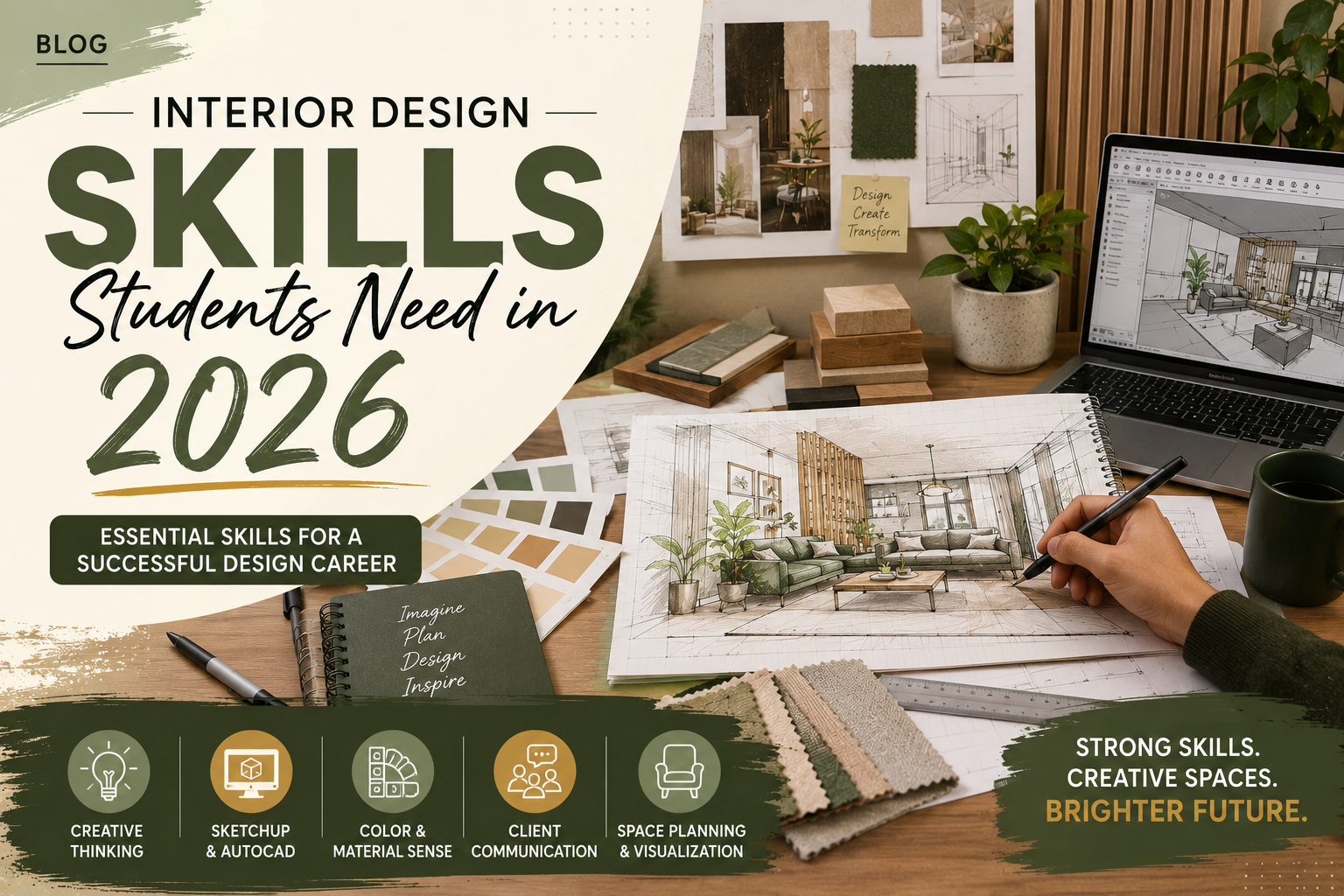
The skills for interior design go far beyond knowing which elements look good together. At NIF Global Jaipur, we train students across creative thinking, software tools, and client communication because all three are needed to build a real career in this field. If you are just starting out, here is an honest breakdown of the key skills that actually matter and where to begin building them.
Why Building the Right Skills for Interior Design Matters More Than Ever
India’s interior design industry is projected to grow from USD 35 billion in 2026 to USD 65 billion by 2031. That is nearly double in five years. Residential interiors are the fastest-growing segment, fueled by rising incomes, new housing projects under PM Awas Yojana, and a generation of young homeowners who want professionally designed spaces. What this means for students is simple: jobs are there. But so is competition. Employers and clients today expect designers who can sketch an idea, turn it into a 3D model, and explain it clearly to a client, all in the same project. The students who invest in the right skills for interior design early are the ones who get hired first.
Creative Skills for Interior Design Where Everything Begins
When people talk about the creative skills for interior design, they usually mean the ability to imagine a beautiful room. But it goes deeper than that. It is about training your eye to understand how a space works, what makes a room feel too small, why one layout flows better than another, and how color, light, and texture interact to create a mood. Here are the creative skills every interior design student should start building early:
- Space planning: Understanding how people move through a room, how to divide a floor plan into functional zones, and how to make even a small space feel open and well-designed. This is the foundation of every project.
- Hand sketching: Quick freehand sketches are still how designers think. Before opening any software, being able to draw an idea on paper, even roughly, helps you think faster and communicate instantly with clients or colleagues.
- Color and material sense: Knowing how to pair fabrics, finishes, and surfaces, and understanding why some combinations feel balanced while others feel off, is a skill that comes from observation and practice, not just theory.
- Mood board creation: A mood board is not decoration. It is a communication tool that shows a client how their space will feel before a single piece of furniture is moved. Learning to build one that is cohesive and convincing is essential from day one.
- Sustainability awareness: Clients today increasingly ask for eco-friendly materials, energy-saving lighting, and responsible sourcing. Knowing the basics of sustainable design is becoming a core skill rather than a bonus.
Try this today: Walk into any room in your home and ask, where does natural light come from? Where is there wasted space? What would you change if you could? This simple habit builds your design eye faster than any textbook.
What Are Technical Skills for Interior Design?
The technical skills for interior design are where most students feel the steepest learning curve, and that is completely normal. Learning software takes time. But here is the good news: you do not need to master everything at once. You need to start with one tool and build from there.
The three software tools that dominate interior design practice in India today are:
- SketchUp: The best starting point for beginners. SketchUp lets you build 3D models of rooms quickly, move furniture around, and create walkthroughs that clients can actually picture. It has a free version, a simple interface, and a massive online library of furniture and objects. Interior designers report 90% greater work efficiency once they are comfortable in SketchUp.
- AutoCAD: The industry standard for technical floor plans and drawings. Architects, contractors, and structural teams all use AutoCAD files. Once you move beyond concept design into actual execution, AutoCAD is the language professionals speak. It reduces measurement errors by up to 99%.
- Adobe Photoshop: Used to enhance 3D renders, create presentation boards, and produce the kind of polished visuals that win clients. Even basic Photoshop skills make a significant difference in how professional your work looks.
Beyond software, technical skills also include reading building codes, understanding basic structural limitations, and knowing minimum safety and accessibility requirements. These are not exciting topics, but they are the difference between a design concept and a design that can actually be built.
A useful fact: Studies show that 3D visualization increases client approval rates by 42%. When a client can see exactly how their space will look before work begins, they make decisions faster and with more confidence. This leads to fewer changes, fewer delays, and a smoother project for everyone.
Communication Skills That Actually Build Your Reputation
Here is something design schools do not always say loudly enough: technical skills get you through the door, but communication skills build your career.
The best interior designers are also good listeners. Before they sketch a single line, they spend time understanding what the client actually wants, not just what they say they want. A client might say “something modern and clean,” but what they mean is “I want my home to feel calm after a busy day.” Learning to hear the difference is a skill you develop through practice and genuine curiosity about people. The communication skills that matter most in interior design are the following:
Understanding client needs: Asking the right questions, reading between the lines, and translating a client’s lifestyle into a design direction. This is the most human part of the job and the most important.
Presenting your ideas: Whether it is a client pitch or a brief to a contractor, you need to explain your thinking clearly to very different audiences. A client needs to feel excited, while a contractor needs exact measurements and material specifications. Both matter.
Managing expectations: Materials arrive late. Budgets change. Walls turn out to be in unexpected places. The designer who handles these moments calmly, communicates honestly, and finds a creative solution is the one who gets referrals.
At NIF Global Jaipur, with over 30 years of experience and mentors who have collaborated with names like Manish Malhotra and Gauri Khan, communication and client skills are taught alongside technical training from the very beginning. This is because a great portfolio in interior design gets you the first meeting, but how you handle that meeting determines everything after it.
How to Start Building Your Skills for Interior Design Right Now
If you are a student just beginning your interior design journey, here is a simple, honest answer: do not try to learn everything at once.
Start with space planning and sketching. Pick up a floor plan, even of your own home, and practice understanding it. Draw rooms by hand. Get comfortable with scale and proportion before you open any software.
Then learn ONE software tool well. SketchUp is the most accessible starting point. Once you can model a room convincingly in SketchUp, you have something real to show. Showing work, even student work, is how confidence and a portfolio are built together.
While you do both of these, practice presenting your ideas out loud. Explain your sketches to a friend. Walk someone through your mood board. Getting comfortable with articulating your thinking early will serve you for your entire career.
NIF Global Jaipur offers interior design programs from the foundation level, open to students from Class 10 onwards, all the way through to advanced and degree-level qualifications, accredited by NSDC, Skill India, and Medhavi Skills University. The structure is designed so that students build these skills in the right order, with real projects, real feedback, and real industry context throughout. If you are ready to start building the right skills, get insights on our interior design programs.
FAQ’s
Q1. What are the most important skills for interior design beginners?
NIF Global Jaipur recommends starting with space planning, hand sketching, and SketchUp. These three skills for interior design build a strong foundation quickly. Pair them with basic communication practice, such as presenting your ideas to others, and you will be ahead of most beginners within your first year.
Q2. Do I need to know software to become an interior designer?
Yes, software is now an essential part of professional interior design practice. Clients expect to see 3D visuals of their space before work begins, and employers expect graduates to be comfortable with tools like SketchUp and AutoCAD. NIF Global Jaipur teaches these as core parts of its interior design programs, not as optional extras.
Q3. Is interior design a good career option in India right now?
Absolutely. India’s interior design market is projected to grow from USD 35 billion in 2026 to USD 65 billion by 2031. Residential interiors are the fastest-growing segment. There is real, sustained demand for trained designers across cities of all sizes, from metros to tier-2 and tier-3 towns.
Q4. What interior design courses does NIF Global Jaipur offer?
NIF Global Jaipur offers interior design programs from foundation certificates, open from Class 10, through advanced specialization and degree-level qualifications. All programs are accredited by NSDC, Skill India, and Medhavi Skills University, with faculty who bring real industry experience to every class.
Q5. Can I start learning interior design skills without any prior experience?
Yes, no prior design experience is needed to begin. NIF Global Jaipur’s foundation programs are built specifically for students who are starting from scratch. What matters most at the start is curiosity, observation, and a willingness to practice. Everything technical can be learned with the right guidance.

Leave a Reply