
The initial months of an interior design course are about building the fundamentals that shape how you think, observe, and communicate as a designer. At NIF Global Jaipur, students beginning their undergraduate interior design journey are introduced to subjects such as Basics of Interior Design, Materials, Visual Communication through Technical Drawings, and more.
Rather than immediately designing complete interiors, the first few weeks help students understand the language of design and develop the skills needed to create functional and visually considered spaces.
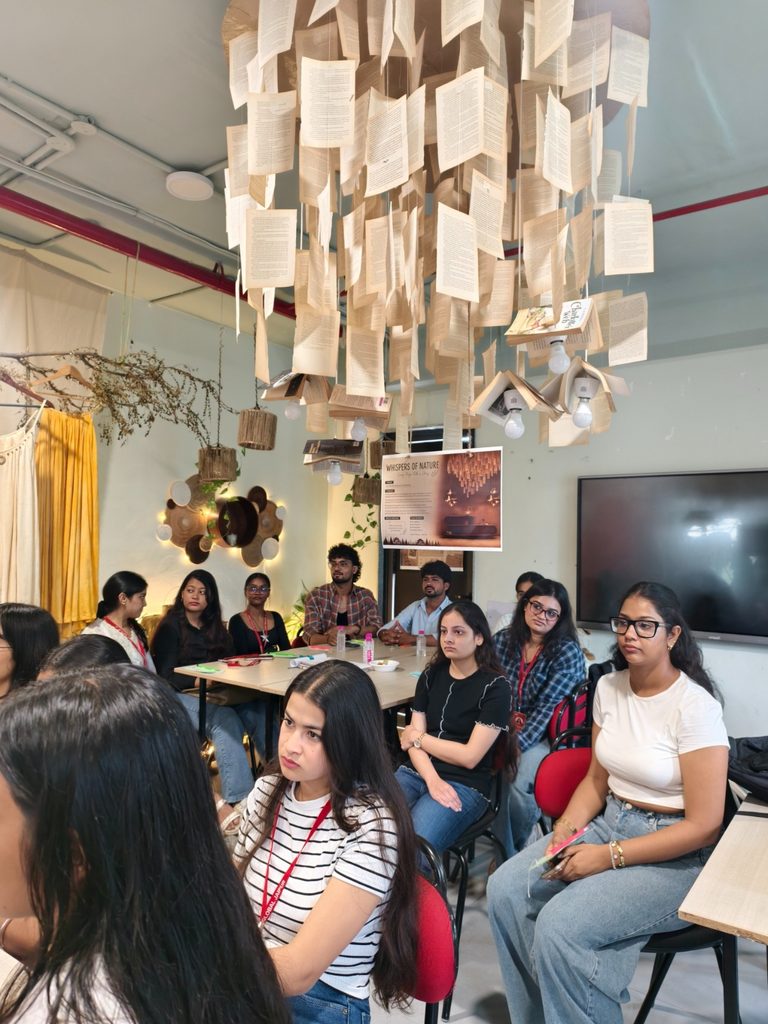
What do you learn in the first month of an interior design course?
The first month typically introduces students to the basic principles and vocabulary of interior design. This is where students begin understanding concepts such as space, proportion, balance, color, form, function, and composition.
Basics of Interior Design provides the foundation for understanding how designers approach a space. Students start looking at interiors not simply as attractive rooms, but as spaces that need to respond to people, movement, functionality, and visual experience.
Students may also begin developing their ability to observe spaces critically. A room that once looked like an ordinary bedroom, living room, or workspace starts becoming a collection of elements that can be analyzed and redesigned.
How do technical drawings become part of your first month?
One of the biggest changes for a student entering interior design is learning how to communicate an idea visually and technically.
Through Visual Communication: Technical Drawings, students begin learning how drawings communicate information about a space. Technical drawings form an important part of professional interior design because designers need to communicate ideas clearly to clients, contractors, and other professionals.
In the beginning, students may focus on understanding drawing conventions, proportions, measurements, and the relationship between a two-dimensional drawing and a three-dimensional space.
This can feel challenging initially, particularly for students who have never worked with technical drawings before. However, these fundamentals gradually help students turn an idea in their mind into something that another person can understand and execute.
Why do materials matter so early in an interior design course?
Materials are central to how an interior looks, feels, and functions. That is why Basic Materials—I forms part of the foundation-level curriculum.
During the early stage of an interior design course, students begin becoming familiar with materials used in interior spaces and understanding their basic characteristics. Durability, texture, maintenance, application, and suitability for a particular space can all influence a design decision.
For example, two materials may create a similar visual effect but behave very differently when used on a floor, wall, ceiling, or piece of furniture.
This kind of differentiation introduces an important idea: every design choice has a functional as well as a visual impact.
What role does design history play in the first month?
Interior design does not exist in isolation. The spaces we create today are influenced by ideas.
Understanding design history and evolution can help students develop a stronger design vocabulary. Instead of simply identifying an interior as “modern” or “traditional,” they can begin asking where particular ideas came from and why certain forms, materials, or decorative approaches became significant.
This historical grounding can also help students avoid designing only from current trends. A strong designer understands trends but also knows the wider design language behind them.
Do you study construction techniques in the first month?
Yes, construction fundamentals are also part of the undergraduate Semester I curriculum through Construction Techniques – I.
At the foundation level, students begin developing an awareness of construction processes and how design decisions connect with the way a space is built.
This is an important distinction between studying interior design and simply studying decoration. Interior designers need to think about the relationship between aesthetics, materials, structure, construction, and usability.
What skills can you start developing in the first few months?
The first month is less about becoming an expert and more about developing the habits that will support your design education throughout the course.
You can expect to begin developing:
- Design observation: Learning to analyze spaces, objects, forms, and proportions.
- Design vocabulary: Understanding fundamental principles and terminology.
- Technical communication: Learning how ideas can be represented through drawings.
- Material awareness: Beginning to understand how materials influence design decisions.
- Historical perspective: Understanding how design ideas have evolved.
- Practical thinking: Connecting creative ideas with construction and functionality.
You may also discover that interior design requires a balance between creativity and discipline. A strong concept needs to be supported by clear thinking, technical understanding and practical execution.
Is the first month difficult for students without a design background?
It can take some adjustment, especially if you have never studied design, drawing, materials or construction before. However, a foundation-level interior design curriculum is designed to introduce these concepts progressively.
Students do not need to know everything before they begin. What matters is curiosity, willingness to learn, and the ability to practice consistently.
For students considering interior design after Class 12, this foundation can be particularly useful because it provides an introduction to both the creative and technical sides of the field.
Conclusion
Your first month of an interior design course is about learning to think like a designer, not simply learning to decorate a room. NIF Global Jaipur’s foundation-level curriculum brings together design principles, materials, technical communication, design history, and construction to give students a strong starting point for their interior design journey.
Explore the Interior Design course at NIF Global Jaipur to learn more about the curriculum, program structure, and opportunities available to aspiring interior designers.
FAQ’s
Q1. What do you study in the first month of an interior design course?
NIF Global Jaipur’s Semester I undergraduate curriculum introduces students to foundational subjects, including Basics of Interior Design, Basic Materials – I, and Visual Communication: Technical Drawings, Evolution of Design: Europe and Construction Techniques – I. The first stage focuses on understanding design fundamentals rather than immediately working on complex interior projects.
Q2. Do I need to know how to draw before joining an interior design course?
NIF Global Jaipur introduces technical drawing as part of the foundation curriculum so students can develop their drawing and visual communication skills as they progress. Prior drawing experience can be useful, but students can build these skills through structured learning and practice.
Q3. What materials do interior design students learn about?
NIF Global Jaipur’s Semester I curriculum includes Basic Materials – I, which introduces students to materials used in interior spaces. Students begin understanding material characteristics and why different materials are suitable for different design applications.
Q4. Is interior design only about decorating spaces?
No. Interior design combines creative thinking with technical, functional, and practical considerations. NIF Global Jaipur’s curriculum reflects this through subjects covering design fundamentals, technical drawings, materials, design history, and construction techniques.
Q5. What should I be prepared for when starting an interior design course?
Be prepared to observe spaces differently, learn new design terminology, practice technical communication, and understand how creative ideas connect with materials and construction. The first month is primarily about building the foundation that you will use for more advanced design work later in the course.

Leave a Reply